
This duty falls to the Art Director of a production. Ken Wong recently filled that role at Spicy Horse for Alice: Madness Returns. Ken is currently working as a freelance illustrator while working on his own self-produced iOS game.
Why is the Art Director important for the success of the game?
What is the greatest challenge you have had to overcome, either with a personal or professional project?
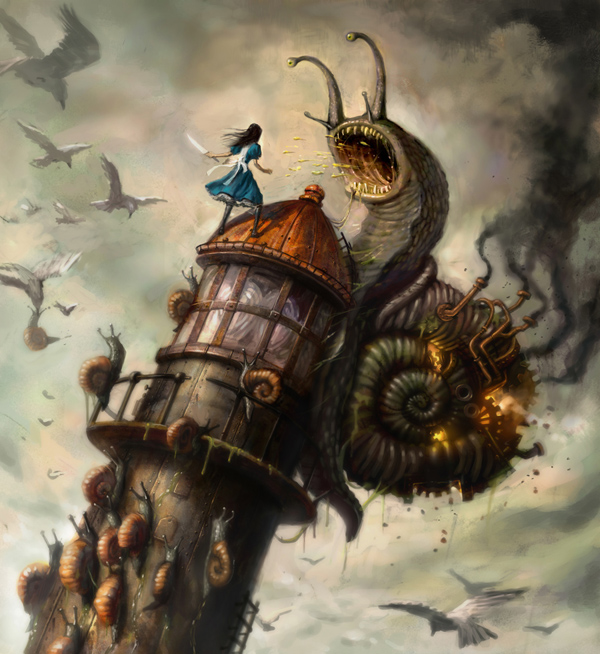
Managing the relatively young and inexperienced Alice: Madness Returns art team (myself included) was probably the biggest challenge. The project came with very high expectations which I really wanted to meet. Sometimes it was hard getting the team to all design together in the same universe.
One of the advantages of the Wonderland world is that anything is possible, but to achieve cohesiveness you need to stick with one particular brand of 'anything.' We'd have fierce arguments about whether certain ideas or looks were right for 'our Alice.'
How did you ultimately decide what your brand of Alice would look like? Was the overall look defined as a collective effort or did you and American have the definitive say on everything?
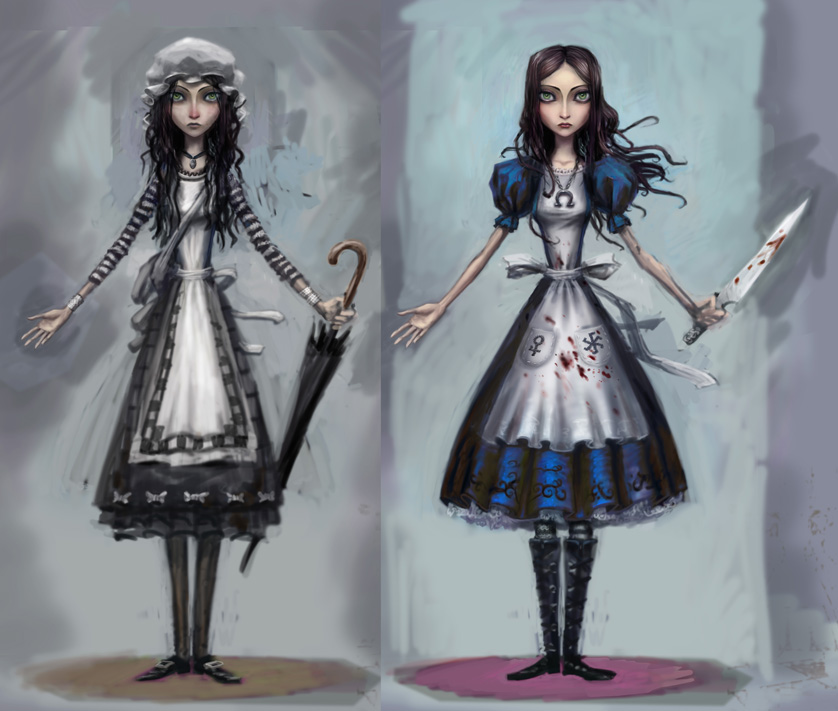
The design of the objects, characters, and environments was a mix. The art team was given a lot of freedom and in some cases the art drove the design and story, rather than the other way around. I tended to give the concept artists starting points, either from the design or from the themes for a particular area, and then challenged them to riff and explore.
What work are you most proud of? Why?
I'm very proud of the art book we released for the game [Alice] through Dark Horse Books. Much of the art in the book wasn't eventually used in the actual game but it documents three years of blood, sweat, and tears, hundreds of great ideas, and some really fantastic images by some superbly talented artists.
How do you see your profession evolving over the next few years?
I actually think the big evolution has already happened after years of stagnation. I think in the next few years the newer models will continue to expand and the 'traditional' market will shrink but not disappear. Smaller agile teams who are able to take bigger risks will come back and perhaps even become the dominant game studio format. This is good because it's encouraging and supporting people to start their own band and find their own sound instead of using American Idol to keep the same, manufactured, status quo.
Very interesting! For the role of Art Director specifically, how do you see it evolving, either with their responsibilities, or the sort of tools they might be using to better do their jobs?
I don't think I really see much evolution for Art Directors except that the small 2 to 10 person teams don't necessarily need one. One trend in the past couple of years is that games for everybody are increasing in popularity and profit compared to games aimed at the 16 to 35-year-old male audience. This somewhat enlarges the palette of art styles we can play with. Of course, there have always been amazing, innovative art styles, but I think in the future more studios will be more open to it.
Are there any techniques/methodologies/best practices you have learned or developed that have served you well?
I think every decision we made art-wise at Spicy Horse had its drawbacks as well as advantages. I think the smart thing is to pick the strategy that best suits your team and current project.
Could you provide any specific examples to help illustrate that point?
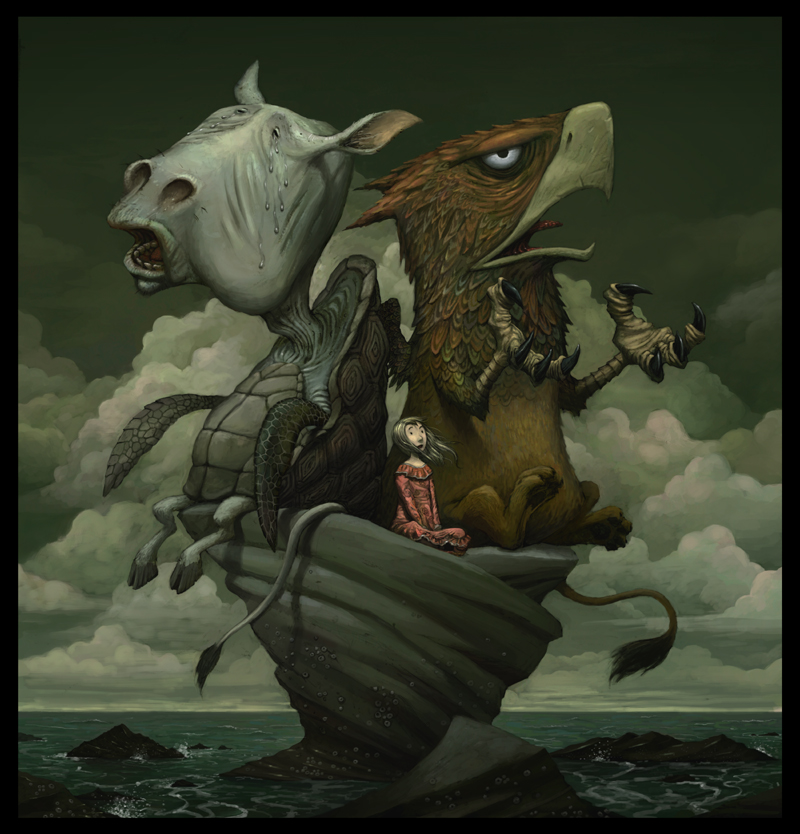
Almost all our 3D assets were outsourced to other companies. To avoid misunderstandings we wanted the specs to be as detailed as possible. Therefore, our team was very concept artist heavy - up to 8 artists at peak time. My background is in concept art so our studio tended to place a lot of emphasis on 2D visualization.
What is the title on which you are currently working?
I'm working on my own iOS game. I don't want to spill the beans too early, but it involves cruelty to cute animals.
Is there anything about your current or most recent title you are particularly excited about in which you are (were) directly involved?
I'm excited about trying to make a game almost entirely by myself (I'm doing the art, animation and coding; I'll outsource the sound and music). It's a long hard road and I might not end up recouping my costs but I'll be able to say “I did that.”
Tell me about your background.
I've always drawn and played games but when I was young I didn't seriously think I could do both as a career. My major at university was multimedia but most of what I know I learned from books and DVD extra features. I spent the past seven years working as an Art Director, first in Hong Kong, then in Shanghai at Spicy Horse. I'm now working as a freelance artist and solo game developer.
What are your inspirations?
Everything around me. If you know how to look you can find a story or an interesting composition or a starting idea anywhere.
Knowing what you know now, what advice would you have given yourself when you were just starting out?
Study mainstream art more. I tend to focus a lot on weird and eccentric art. I'm not so good at just making a really appealing illustration that will work for a broad audience. The ideal situation for a commercial illustrator is to do both at the same time: to create something unique and fresh that lots of people can get.
What is your current title, and if you were to describe what you do with your own self-title, what would it be?
Not-Quite-Starving-Creative. I'm getting enough freelance illustration jobs that I'm not starving. I just moved to the Philippines for a while. I'm not a pure artist, as I do a little writing and I'm doing both art and programming on a little iOS game.
What motivated you to work in the game industry?
The opportunity to get paid for fantasy art. The comic book, card game, magazine/book industries are a lot tougher for an artist to start out in. Plus I didn't really seek games out, the industry kind of found me.
How did the industry find you?
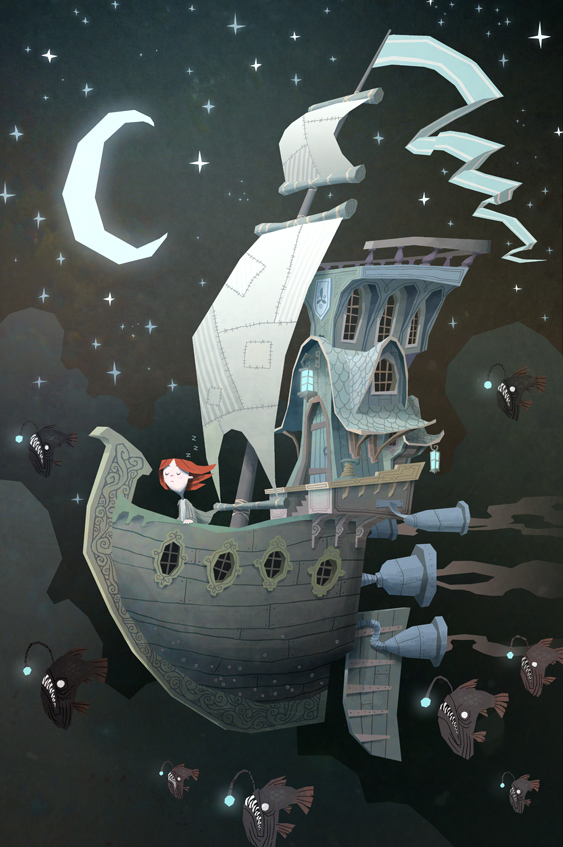
What are your favorite games and why?
Super Metroid because it's simply a masterpiece. It achieves so much atmosphere and adventure with almost no text. Street Fighter because its mechanics are so sublime. I think the reason Ryu still plays like Ryu 20 years later is because they really nailed a great feeling. Finally Sword & Sworcery because it's an utterly amazing piece of work and goes against everything conventional wisdom says you should be doing in games right now.
What are you playing right now?
Right now I do all my gaming on an iPad. I've been playing Super Crate Box, Spell Tower and Sword & Sworcery.
Thank you for your time Ken!


Thanks for awesome interview.
ReplyDeleteAwsome interview! Great arts.
ReplyDeleteThank you for introducing me to my new favorite person named Ken. I didn't know any other Kens before Ken Wong, but I'm sure the next Ken I meet will not meet my expectations.
ReplyDeleteAlso, Sword & Sorcery is slow to start, but seriously worth it. Playing it on my iPod now.